How to Judge an Electric Bike: The Specs That Matter
Bikes 4 min read Updated
An e-bike spec sheet is written to sell, not to inform. The numbers that get the largest type are frequently the ones that predict the least about whether you will enjoy the bike, and the ones that matter most are often buried or missing entirely.
This is how to read one. For which kind of bike to buy, see the guide to the four styles.
The number they lead with, and why to distrust it
Motor wattage
Almost always the headline, and almost always the least useful figure on the page. Wattage describes power draw, not capability, and it is quoted inconsistently — some brands publish sustained output, others peak, and peak can be double.
What you actually want is torque in newton-metres. Torque is what gets you up a hill without standing on the pedals. A 250 W mid-drive with 85 Nm will climb better than a 750 W hub motor with 45 Nm, which is the opposite of what the marketing implies.
Top speed
A legal limit, not an engineering achievement. Class 1 and 2 bikes cut assist at 20 mph; Class 3 at 28 mph. Every bike in a class tops out identically, so the figure tells you nothing about the bike — only about where you may legally ride it.
The numbers that actually predict satisfaction
Watt-hours
Battery capacity, and the real determinant of range. Multiply volts by amp-hours if the brand only publishes those: 48 V × 14 Ah = 672 Wh. Anything around 500 Wh is a genuine commuting battery; below 400 Wh you will be thinking about charging.
Watts are draw, watt-hours are capacity. A bike with a big motor and a small battery is fast and short-legged.
Torque, in Nm
Roughly: 40–50 Nm is fine on flat ground, 60–75 Nm handles most hills, 85 Nm and above is what cargo bikes and steep terrain need.
Sensor type
The specification that changes the ride most and gets mentioned least.
A cadence sensor detects that the pedals are turning and applies a fixed assist level. The result is a slight lurch as it engages and a disconnected feeling — the bike is either helping or not.
A torque sensor measures how hard you are pushing and scales assist proportionally. The bike feels like a bicycle that is simply easier, which is what most people actually want. If a spec sheet does not say which one it has, assume cadence.
Motor placement
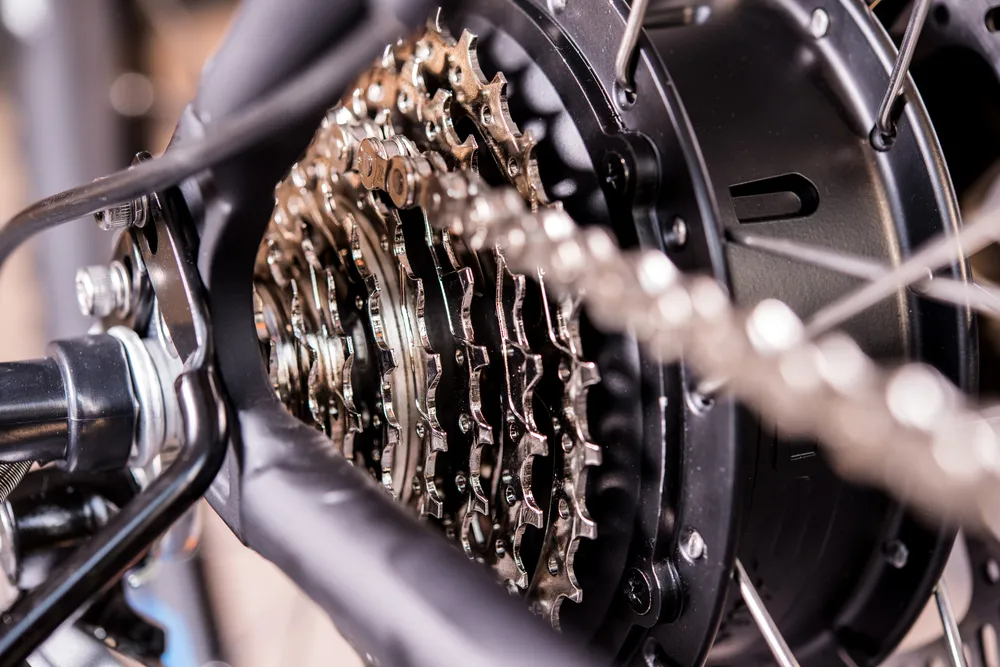
A mid-drive sits at the cranks, keeps weight low and central, and drives through the bike's gears — which means it multiplies torque in low gear and climbs far better. A hub motor sits in a wheel, is cheaper and simpler, and is perfectly good on flat ground. Mid-drives cost more and wear chains faster.
Weight
Rarely advertised, always relevant. It determines whether you can lift the bike onto a rack, carry it up a step, or ride it home with a flat battery. A 70 lb bike with a dead battery is close to unrideable.
Brakes
Hydraulic disc brakes. These bikes are heavy and travel at 20–28 mph, and mechanical discs fade under repeated hard stops. This is not a place to economise.

Battery safety certification
This did not appear on spec sheets when this guide was written and now belongs near the top of the list.
Look for UL 2849 (the complete bike's electrical system) or UL 2271 (the battery pack). After a run of fires traced to uncertified cells and chargers, several cities now restrict uncertified e-bikes in residential buildings, and some insurers ask. Certification is also a reasonable proxy for whether a brand takes its supply chain seriously.
Related: use the charger that came with the bike, and do not charge it overnight in a hallway or a doorway.
How to read a range claim
Quoted range is generated in the most favourable conditions available: lowest assist, flat ground, mild weather, light rider, no wind, no cargo. None of that will describe your commute.
Plan on roughly two thirds of the claim, and less than that if you are heavy, the route is hilly, the weather is cold, or you use high assist. Where a brand publishes a range at a stated assist level and rider weight, that is a brand worth taking more seriously.
What is missing from the sheet
Three things that matter and are almost never printed:
- Spare parts and support. Proprietary batteries and motors become a problem in year four. Ask whether replacement packs are sold separately and what they cost.
- Warranty on the battery specifically. It is usually shorter than the frame warranty and it is the expensive part.
- Whether a local shop will service it. Many will not touch a direct-to-consumer brand they cannot get parts for. Ask before buying, not after.
The short version
Ignore motor wattage and top speed. Read watt-hours, torque, sensor type and weight. Insist on hydraulic brakes and a UL certification. Discount the range claim by a third. Then go and ride the bike, because none of these numbers tell you how it fits you.
Electric Bike Review publishes measured figures rather than manufacturer claims, which makes it the useful place to check a specific model against the standards above.