Your Guide to the Self-Balancing, One-Wheeled Electric Skateboard
Recreation 4 min read Updated
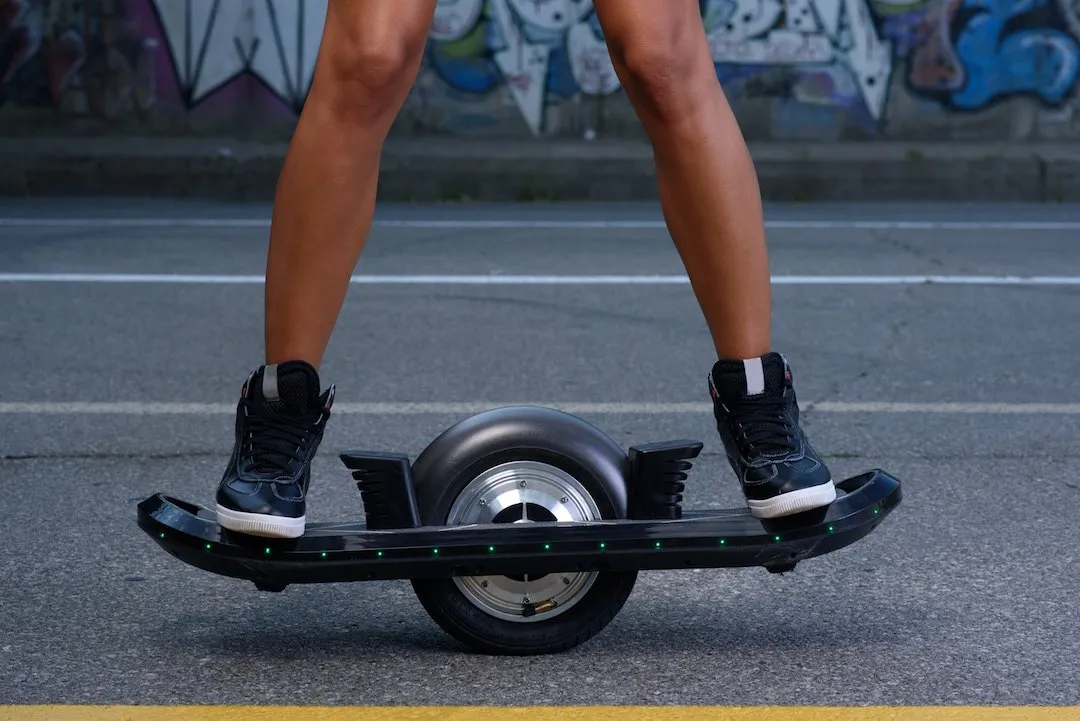
A one-wheeled electric skateboard is a single go-kart-sized tyre in the middle of a board, with your feet either side of it. It has no handlebars and no remote. You lean forward to go, lean back to slow, and the board's gyroscopes and motor do the rest thousands of times a second.
It is the closest thing to a snowboard that works on pavement, and it is the most engaging machine covered anywhere on this site. It also has the most serious safety record, so start there.
Read this first: the 2023 recall
In September 2023 the US Consumer Product Safety Commission and Future Motion, the maker of Onewheel, recalled all 300,000 Onewheel boards sold in the United States. Four deaths were reported between 2019 and 2021, along with dozens of injury reports.
The hazard is inherent to how these machines work. The board balances you by driving the wheel; if you exceed what the motor can deliver — too steep, too fast, too much load, too little battery — it cannot hold you up, and the nose drops while you are still moving. Riders call it a nosedive. It happens fast and it puts you on the ground in front of the board.
The remedy was a firmware update adding Haptic Buzz, a tactile and audible alert that warns you as the board nears its limits, in low battery, or in an error state. It works alongside the older pushback warning, where the board lifts the nose to tell you to slow down.
What this means if you are buying:
- Buying new. Current boards ship with Haptic Buzz. Nothing to do.
- Buying used. Confirm the board has been updated. A GT, Pint X, Pint or +XR that has never been connected to the app may still be on pre-recall firmware.
- An original Onewheel or Onewheel+. These could not be fixed with firmware. Future Motion offered a pro-rated store credit on proof of disposal via recall.onewheel.com. Do not buy one.
None of this makes the machine unrideable — hundreds of thousands of people ride them without incident. It makes protective equipment non-optional, and it means the warnings the board gives you are not suggestions.
How it works
Inside the board are gyroscopes and accelerometers reading its attitude hundreds of times a second, a controller, and a hub motor inside the tyre. Tilt the nose down and the controller drives the wheel forward to get back under you. Lean back and it slows, then reverses. There is no throttle because your body weight is the throttle.
Two consequences follow, and they explain most of what the machine feels like:
- It is only as strong as its motor. Balance is maintained by driving the wheel, so asking for more than the motor can supply ends the balancing. This is why hills, headwinds, heavy riders and low battery are all versions of the same problem.
- Battery level affects handling, not just range. A near-empty pack cannot deliver full current, so the board's limits fall as it drains. The last mile is the riskiest one.

The current lineup
Future Motion still defines the category. The range splits by board size and power.
- Pint — the entry point. Roughly 6–8 miles of range and 16 mph. Small, light, easy to carry, and the right first board.
- Pint X — the same compact format with more of everything: about 12–18 miles and 18 mph. The best balance of size and capability for most riders.
- GT — the full-size board. Around 20–32 miles and 20 mph, with the torque to handle hills and heavier riders properly.
- GT S-Series — the performance version, on a 113 V powertrain, quoted at up to 25 mph and 25 miles. Meaningfully more capable and meaningfully less forgiving.
Competitors exist, but parts availability, firmware support and secondhand value all still favour the original.
Which one
Buy on torque and rider weight, not range. A heavier rider on a Pint will reach the board's limits on hills a GT would not notice, and reaching the limits is the thing that hurts. If you are over roughly 200 lb, or your area is hilly, start at the GT.
If you are lighter, on flat ground, and carrying the board onto public transport, the Pint or Pint X is the better machine and the easier one to live with.
What it is genuinely good and bad at
Good: grass, gravel, packed dirt and kerbs, thanks to the single fat pneumatic tyre. Tight spaces. Carrying indoors. And the ride quality itself, which is unlike anything on two small wheels.
Bad: range, compared with a scooter at similar money. Wet surfaces, where traction on a single tyre is a real limitation. Long commutes. And the learning curve — expect a few hours before it feels natural, and expect to fall during them.
The gear that is not optional
Given how these fail, this list is short and not negotiable:
- A helmet. Every ride, including the short one.
- Wrist guards. A nosedive puts you forward onto your hands.
- Knees and elbows, at least while learning.
- Charge before you ride, and treat the low-battery warning as a hard stop.
Learn on grass. It is slower, it is more forgiving, and every experienced rider says the same thing.
If the lean-to-steer idea appeals but the single wheel does not, conventional electric skateboards use a remote and four wheels, and hoverboards apply the same self-balancing principle with two.