Electric Bike Technology: 7 Things You Should Know Before Buying Your Electric Bike
Bikes 5 min read Updated
Some of the advantages of electric bikes over the typical bicycles include better range, wind resistance, and climbing efficiency.
If you’re struggling with exercise-induced asthma or knee pain, electric bikes are also perfect for you. Apart from all these benefits, e-bikes also offer the good-old benefits that you get from traditional bikes – health benefits, connection to the community, and cost efficiency.
Finding the perfect starter motor electric bike can be daunting. There are so many specifications and options to consider. Here some of the key aspects of electric bikes and what to consider when buying one from electric bicycle companies.
Top 7 Things to Consider When Buying an Electric Bike
1. Your Needs
Understanding your needs will help you focus on the right electric bike specifications. E-bikes are designed for different cyclists and different uses. You should decide on what specs to prioritize on.
If you love riding for long distances, then you should consider an e-bike with a battery of over 400 watt-hours. And if you ride on hilly terrain, then a mid-mounted motor or a hub motor of 200 watts will serve you well.
The bottom line is, understand your biking needs.
2. Drive
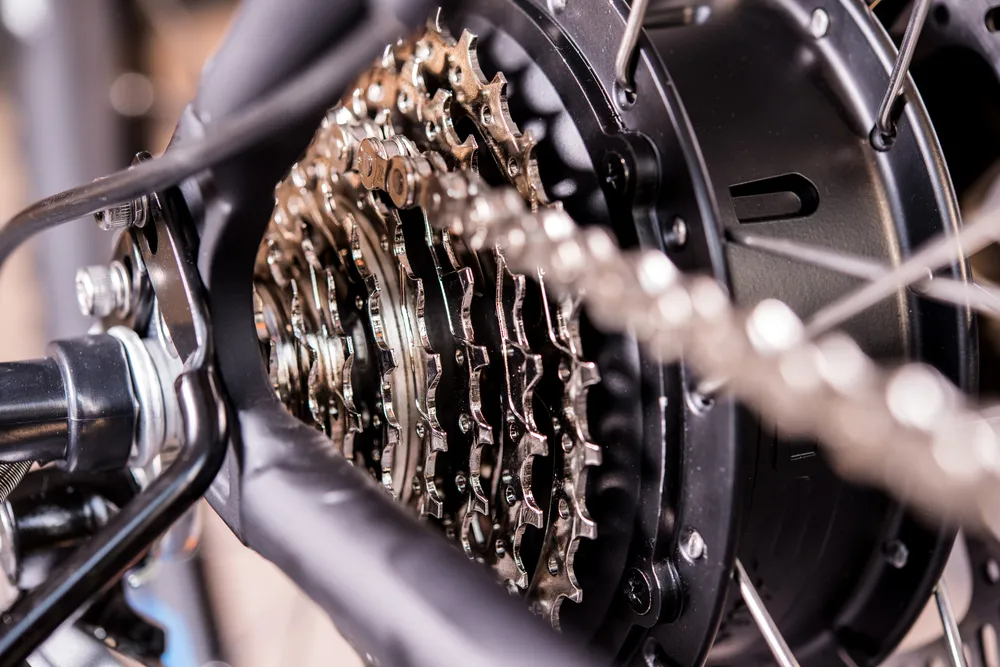
E-bikes are clustered into two main types based on the location of the motor – mid-drive e-bikes and hub motor bikes.
Mid-drive e-bikes are the most common type. They are equipped with a system that monitors your cycling and mechanically infuses motor assistance – typically depending on speed, force, and rate.
Where the motor sits matters more than its wattage. A mid-drive at the cranks drives through the bike's gears, so it multiplies torque in a low gear and climbs markedly better. A hub motor sits inside a wheel, is cheaper and simpler, and is perfectly adequate on flat ground.
Speed is set by class, not by the motor. Most US states use a three-class system: Class 1 assists to 20 mph with no throttle, Class 2 adds a throttle at the same 20 mph limit, and Class 3 assists to 28 mph. Assist cuts out at the limit — you can still pedal faster, the motor just stops helping. In the EU and UK the equivalent limit is 250 W and 15.5 mph.
Anything designed to exceed those limits stops being a bicycle in law and becomes a moped or motorcycle, which is where licensing, insurance and registration start to apply. Class 3 bikes are also barred from many shared-use paths and often carry a minimum age. The rules differ by state, so check what applies where you actually ride before buying.
3. Warranty and Support
Buying an electric bike is a considerable investment, and purchasing one from a reliable shop is a smart move. Any reputable dealer should offer after-sales services, advice on use and maintenance, and any other help that you may need.
It’s also wise to buy from established and reputable electric bike companies. Established brands are more likely to provide replacement parts in the future and their quality is more likely to be consistent.
You should also find out what type of warranty is available for an e-bike. It may be different for various components of the bike.
The length of your warranty is always a good indicator of the quality and reliability of a bike.
4. Battery
Over time, batteries will degrade and hold less charge. The quality of the battery is critical to the durability of your e-bike.
Go for reputable brands with good batteries that offer at least a two-year warranty. E-bikes with advanced electric bike technology have higher-tech batteries that charge faster and can last longer.
Check for safety certification. This did not exist as a consumer concern when this guide was first written and now belongs at the top of the list. Look for UL 2849 covering the bike's whole electrical system, or UL 2271 covering the battery pack. After a run of fires traced to uncertified cells and mismatched chargers, several cities now restrict uncertified e-bikes in residential buildings, and some home insurers ask about it. Always use the charger supplied with the bike, and do not charge it overnight across a hallway or a doorway.
Capacity is quoted in watt-hours (Wh) — multiply volts by amp-hours if a brand publishes only those. Around 500 Wh is a genuine commuting battery. Watt-hours, not motor wattage, are what predict how far you get.
5. Range
The range is basically how far an e-bike can go on a fully charged battery. It’s one of the most critical specs on a bike.
Treat the manufacturer's figure as an upper bound. It is measured at the lowest assist level, on flat ground, in mild weather, by a light rider — conditions that will not describe your commute. Plan around roughly two thirds of the quoted number, and less in cold weather or on hills.
For instance, if you commute for 10 miles, you wouldn’t want a bike that will run out of power halfway. The range depends on a lot of things like the electric bike technologies, the weight, battery capacity, pedaling power, and the terrain of the commute.
Moreover, an e-bike with a 50-mile range won’t add much value to your commute if you only cover 20 miles per day. However, you should buy a bike with a relatively higher range because as the batteries lose capacity over time, their range drops.
6. Comfort
You’re less likely to ride your bike if it’s not comfortable.
For comfort, the key features to focus on are the frames and the seat.
When riding a mountain bike or road bike, you have to lean a little bit forward. However, for e-bikes, a lot of people prefer the upright position.
To find a bike that suits your preferred driving style, you should test drive it. Small changes in the geometry can make a significant difference on how you feel when riding.
7. Costs
You can get a cheaper model, but how well will it serve your needs?
Building an e-bike with a solid frame and state-of-the-art components is not cheap. So don’t focus so much on the price. You may pay a little more for a quality bike, but it’ll definitely last longer.
Get Your Ideal Electric Bike Today!
If you don’t know what you exactly want, purchasing an e-bike can be quite overwhelming.
However, test driving a bike allows you to answer the fundamental questions that reviews and research can’t answer – “Do I love it enough to buy it?”
Always ask yourself this question before striking a purchase deal.
Happy riding!